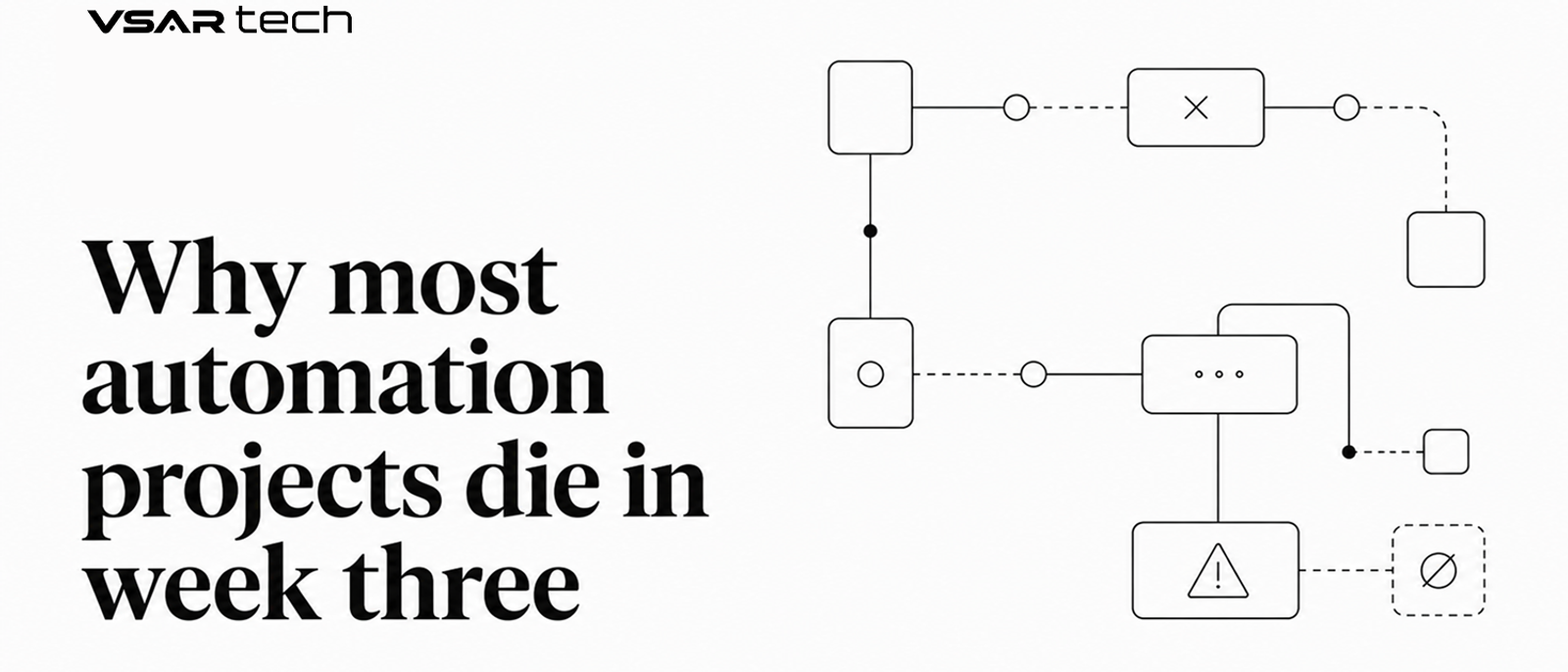
Most automation projects do not fail in the demo. They fail about three weeks after the demo, when the process meets its first messy week of real volume and nobody owns what happens next.
That timing is not a coincidence. It is the point where three separate problems, an exception backlog nobody is tracking, an owner who quietly moved on, and a process that was never actually redesigned, arrive at the same time. Most post-mortems blame "change management" or "user resistance," which is true in a shallow sense and useless in a practical one. It does not tell the next team what to do differently.
This piece breaks down what actually happens in those three weeks, what the evidence says about how often this pattern repeats, and a specific set of checks that catch the failure while it is still cheap to fix.
- Automation failure clusters around week three, not week one, because that is when real-world exception volume first exceeds what the pilot was tested against.
- EY's automation practice has widely reported that 30% to 50% of initial RPA and automation initiatives fail to deliver their expected value, a figure repeated across the RPA industry since roughly 2019.
- Deloitte's Global RPA Survey has repeatedly found that only a small fraction of organizations ever scale automation beyond a handful of processes, with most stalling well short of production maturity.
- The fix is not more training. It is assigning a named process owner, building an exception log from day one, and setting an explicit kill-or-continue decision point before the project starts.
The Conventional Explanation, and Why It Falls Short
Ask most consultants why an automation project failed, and the answer is usually some version of "change management." Employees did not trust the new tool, leadership did not reinforce adoption, or training was insufficient. This explanation is popular because it is often partly true. People do resist tools that change how they work, and a rushed rollout with no coaching will always underperform a careful one.
The problem is that change management explains resistance to a working tool. It does not explain why a tool that worked fine in the pilot starts breaking three weeks after go-live, in ways nobody predicted, on a team that was enthusiastic about the change on day one. Blaming adoption treats the automation as static and the people as the variable. In the week-three failure pattern, it is usually the other way around: the people show up ready to use the thing, and the automation itself cannot keep up with what real work actually looks like.
The Three-Week Arc
The pattern is consistent enough across process automation, RPA bots, and workflow tools that it is worth naming its stages directly.
Week One: The Demo High
The pilot ran on a curated batch of cases, usually the clean ones the team used to build and test the automation. It hits its numbers, the demo goes well, and stakeholders approve a wider rollout. At this point, everyone involved genuinely believes the hard part is over. It is not. The hard part has not started yet, because the pilot has not yet met the full variety of real inputs.
Week Two: The First Real Cracks
Real volume starts flowing through the process, and with it comes the long tail of edge cases: a vendor name formatted differently than expected, a document missing a field the automation assumed would always be there, an approval step that gets skipped in a way the workflow did not anticipate. Individually, each exception looks minor. The team handles the first few manually and moves on. Nobody is logging them systematically, because logging exceptions feels like overhead when the project is "basically done."
Week Three: The Quiet Abandonment
By week three, the exception count has not gone down. It has accumulated, because nobody was assigned to fix the underlying causes, only to work around them one at a time. The person who built the automation is now busy with the next project. The business owner assumed IT would maintain it; IT assumed the business owner would flag problems. Both are technically right, and the process quietly reverts to manual handling for a growing share of cases. Nobody announces the failure. There is rarely a single dramatic outage. The automation simply stops being the default path, and within a few more weeks it is running at a fraction of its intended volume, if it is running at all.
What Actually Causes the Collapse
Underneath the three-week arc are a small number of structural causes that repeat across industries and tools.
| Root Cause | What It Looks Like | Why It Bites at Week Three Specifically |
|---|---|---|
| No named process owner after go-live | The builder moves to the next project; the business unit assumes IT owns maintenance | Exceptions have nowhere to land, so they pile up until someone notices the backlog |
| Exceptions treated as one-off bugs, not design input | Each new edge case gets a manual workaround instead of a process fix | The workaround pile grows faster than the team can absorb it, usually around week two to three |
| Process automated as-is, never redesigned | The messy manual process was scripted, not simplified, before automating | Every quirk in the old process becomes a new failure mode at scale |
| No maintenance budget or time allocated | The project's cost model ends at go-live | The first schema change, API update, or seasonal volume spike has no owner to absorb it |
The common thread is that all four causes are invisible during the pilot. A pilot, by definition, runs on a small, hand-picked sample and gets constant attention from the people who built it. Every one of these failure modes only shows up once the automation is running unattended on the full range of real cases, which is exactly what week three looks like.
What the Evidence Shows
The week-three pattern lines up with what industry research has said about automation failure for years, even if most of that research does not use this specific timeframe.
EY's automation practice has been widely cited, across the RPA industry and by competing consultancies, for the finding that 30% to 50% of initial RPA projects fail to meet their goals. That figure has circulated since roughly 2019 and is one of the most repeated statistics in enterprise automation, precisely because it matches practitioners' lived experience: getting a bot to work is the easy part, and getting it to keep working is where most initiatives lose momentum.
Deloitte's Global RPA Survey has separately and repeatedly found that scaling, not piloting, is where most organizations stall. In its various editions, Deloitte has reported that only a small minority of organizations ever grow their automation programs past a handful of processes into genuinely broad deployment, even though the large majority of pilots are rated successful at the point of launch. Read together, the EY and Deloitte findings describe the same gap from two angles: pilots clear the bar; production does not.
How to Survive Week Three: A Practical Framework
The fix is not a bigger training budget. It is closing the three structural gaps that the pilot phase hides.
- 1.Name a process owner before go-live, not after. This person is accountable for the automation's health for its full life, not just its launch. If no one will take this role, the project is not ready to go live.
- 2.Build the exception log on day one. Every case that falls out of the automated path gets logged with a reason, starting with the very first real transaction, not after the backlog becomes visible. A log that starts in week four is already too late to catch the pattern while it is cheap to fix.
- 3.Review the exception log weekly for the first six weeks. Most root causes are visible within the first ten to twenty logged exceptions. Waiting for a monthly report means the automation has already reverted to manual handling by the time anyone looks.
- 4.Redesign before you automate, not after. If the manual process has known quirks and workarounds, fix those first. Automating a messy process at speed just means the mess now runs unsupervised.
- 5.Set a kill-or-continue checkpoint at week three, on the calendar, before launch. Decide in advance what "healthy at week three" looks like, in terms of exception rate and manual fallback volume, so the decision to keep going, fix, or shut it down is made on evidence instead of momentum or embarrassment.
You will know the framework is working if the exception rate is falling by week three instead of climbing, and if the process owner can name the top three recurring exception causes without checking a report first. Most teams that implement this see the difference within the first month, because the log surfaces the same two or three root causes well before they compound into a full reversion to manual work.
A Week-Three Checklist
| Check | Healthy Sign | Warning Sign |
|---|---|---|
| Process owner | Named person, explicitly accountable past go-live | "IT will handle it" or no one can answer who owns it |
| Exception log | Started before go-live, reviewed weekly | Does not exist, or only started after problems appeared |
| Exception trend | Flat or falling by week three | Still climbing, or nobody has counted them |
| Manual fallback volume | Small and shrinking | Growing quietly, with no one tracking the percentage |
| Kill-or-continue decision | Set on the calendar before launch, with defined criteria | No defined checkpoint; the project just fades |
A Caveat Worth Stating Plainly
Not every automation failure fits this pattern. Projects with genuinely poor executive sponsorship can fail in week one, before exception volume ever becomes the issue, and some processes are simple enough that the pilot's clean sample really does represent the full range of real cases. The three-week arc described here is most reliable for processes with meaningful variability: document handling, multi-system workflows, and anything touching external parties whose data does not conform perfectly to what the automation expects. For narrow, highly standardized processes, this specific failure timeline may not apply, even though the underlying advice, name an owner, log exceptions, redesign before automating, still holds.
Frequently Asked Questions
Doesn't better training just fix this?
No, not on its own. Training helps people use a tool correctly; it does not fix a process that was automated without redesign or a maintenance model that has no owner. A well-trained team using an under-maintained automation will still watch it degrade by week three, because the problem is in the process design and ownership, not in how well anyone was taught to click the buttons.
What if we already went live without an exception log?
Start one immediately, even mid-flight. Pull the last two weeks of cases that fell back to manual handling, categorize the reasons, and you will usually see the same two or three root causes the log would have caught on day one. It is not too late to apply the framework; it just costs more to catch problems that have already been running unlogged for weeks.
The Bottom Line
Automation projects rarely fail because the technology does not work. They fail because nobody is watching what happens after the demo ends, and week three is reliably when that gap becomes visible. Assign an owner before launch, log exceptions from day one, redesign the process instead of just scripting it, and set a real decision point for week three. Do that, and the "week three problem" stops being a mystery and starts being a manageable, predictable part of the rollout.